UPS Claims Quick Wins
Overview
2x Increase Improved the Overall Experience and Reduced Cost While Breaking Records Along the Way!
My Role
UX Designer
The Team
1 Product Manager
1 Product Owner
8 Software Engineers
1 UI Designer
Timeline
3 Months August 2021 - October 2021
Background
The claims process is complex, slow, and unreliable for some causing frustration amongst consumers and business owners.
During the 2020 peak season, UPS managed an average of over 30 million packages daily, a substantial increase that required the hiring of more than 100,000 seasonal employees to effectively accommodate the surge in demand. This significant rise in volume inevitably led to a corresponding increase in claims for lost or damaged packages. To maintain high service levels and customer satisfaction, UPS enhanced its customer support infrastructure to ensure timely and efficient issue resolution. Out of the 432 million visitors to UPS.com in the second quarter of 2021, approximately 1.2 million (0.2%) initiated the process of filing a claim. While the volume of claims traffic remains relatively low compared to other website activities, claims are an essential and unavoidable part of the logistics process and hold great importance for many customers. In fact, “Claims” ranks as the number one search term on UPS.com, underscoring its critical role in the customer experience.
The Challenge
The UPS claims submission process suffered from unnecessary complexity and friction, leading to poor completion rates and customer dissatisfaction. Users encountered unclear communication, confusing navigation, and lengthy processing times throughout their journey.
Current State: "Resolve a Claim" is UPS's lowest-scoring customer journey, with a cNPS of 16—significantly behind FedEx (24) and Amazon (38). Forrester's UPS.com audit identified multiple usability issues that create barriers to successful claim submission. Of the 1.2M users who began the claims process in Q1 2021, only 25% completed it. Furthermore, approximately 70% of submitted claims are rejected, and only 30% result in approved payments.
Impact: This creates a competitive disadvantage for UPS and damages customer trust, as users experience frustration with an average 57-step process taking approximately 15 minutes to complete.
“Of all claims filed on UPS.com, approximately only 30% are approved and paid”
“Of the 1.2M users who began the claims process on UPS.com in Q1 2021, only 25% completed it. ”
Can we identify quick wins that will increase completion rates with the UPS claims process?
The Hypothesis
If we implement quick wins to the claims process by simplifying screens, clarifying navigation, and humanizing language, we can improve completion rates and satisfaction.
Research
We conducted a comprehensive audit of the existing claims submission process to identify friction points and areas of complexity within the user journey. This foundational analysis provided clear insights into current challenges and established a baseline for improvement.
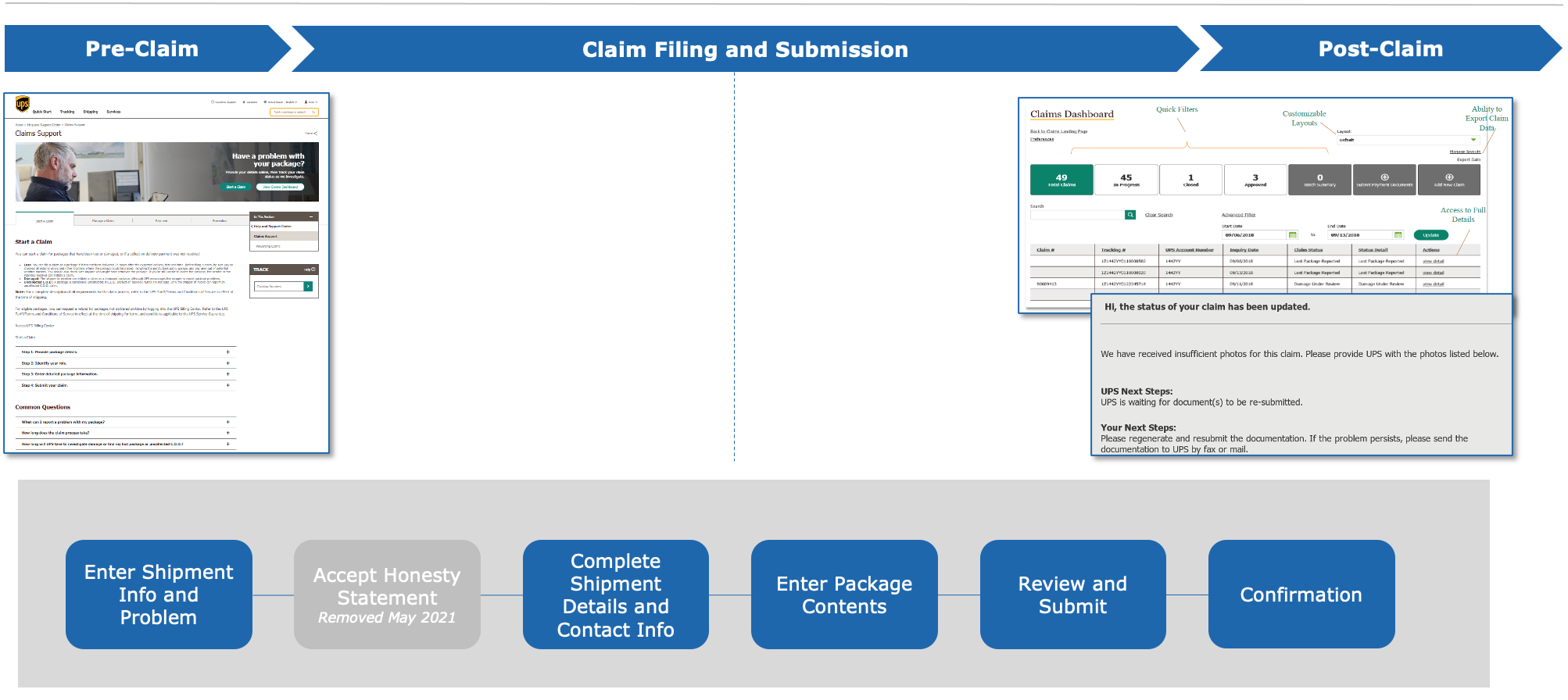
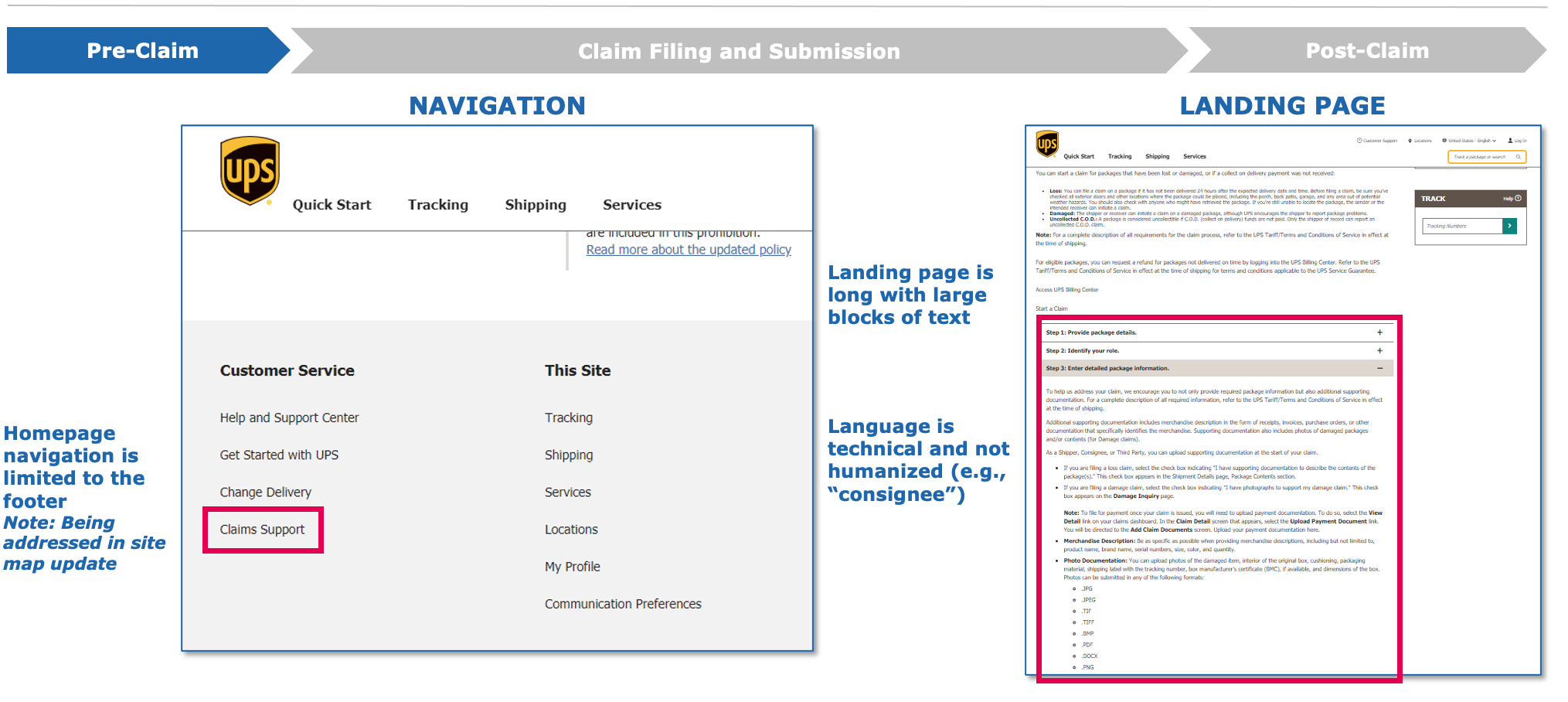
It is difficult to navigate to claims support (which is why claims is the #1 search term on UPS.com)
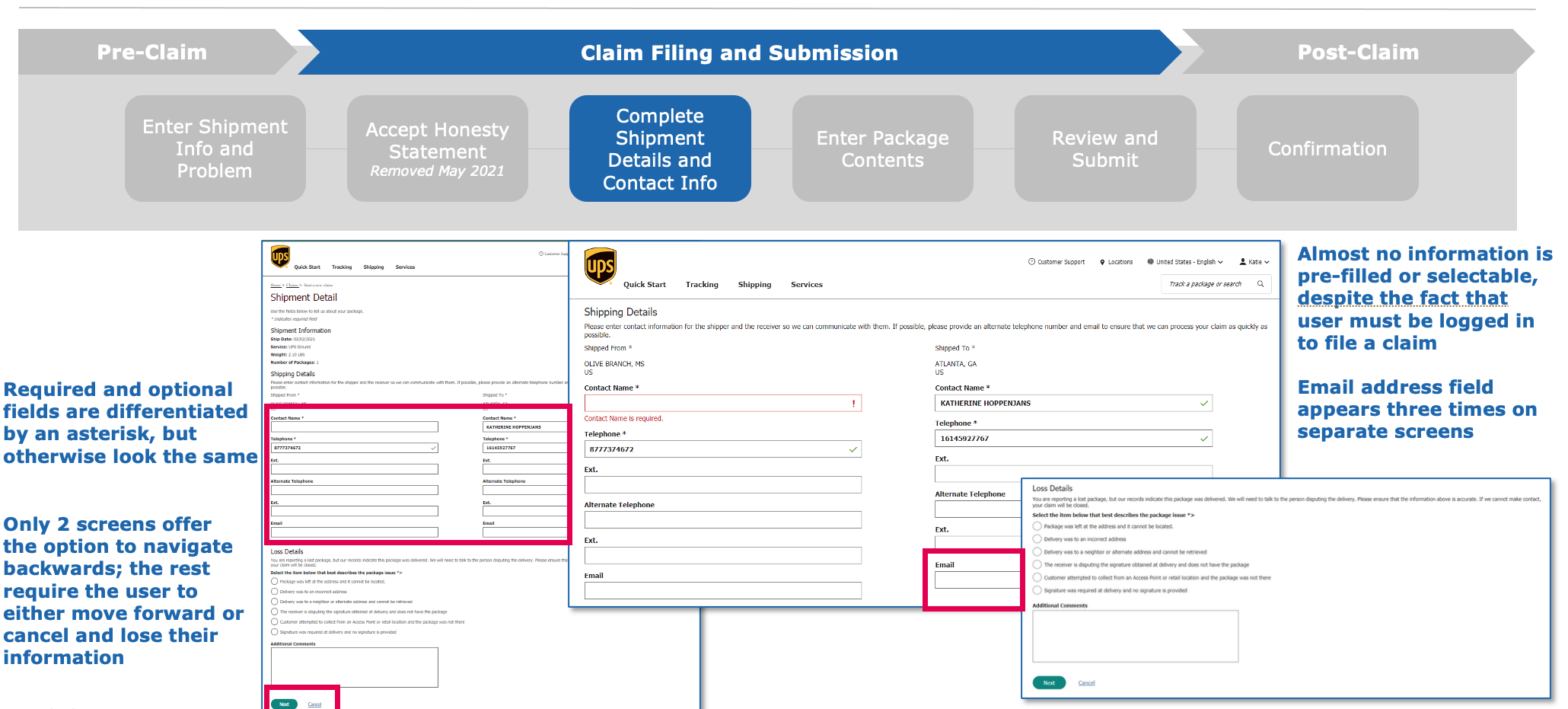
Length and appearance of forms feels overwhelming
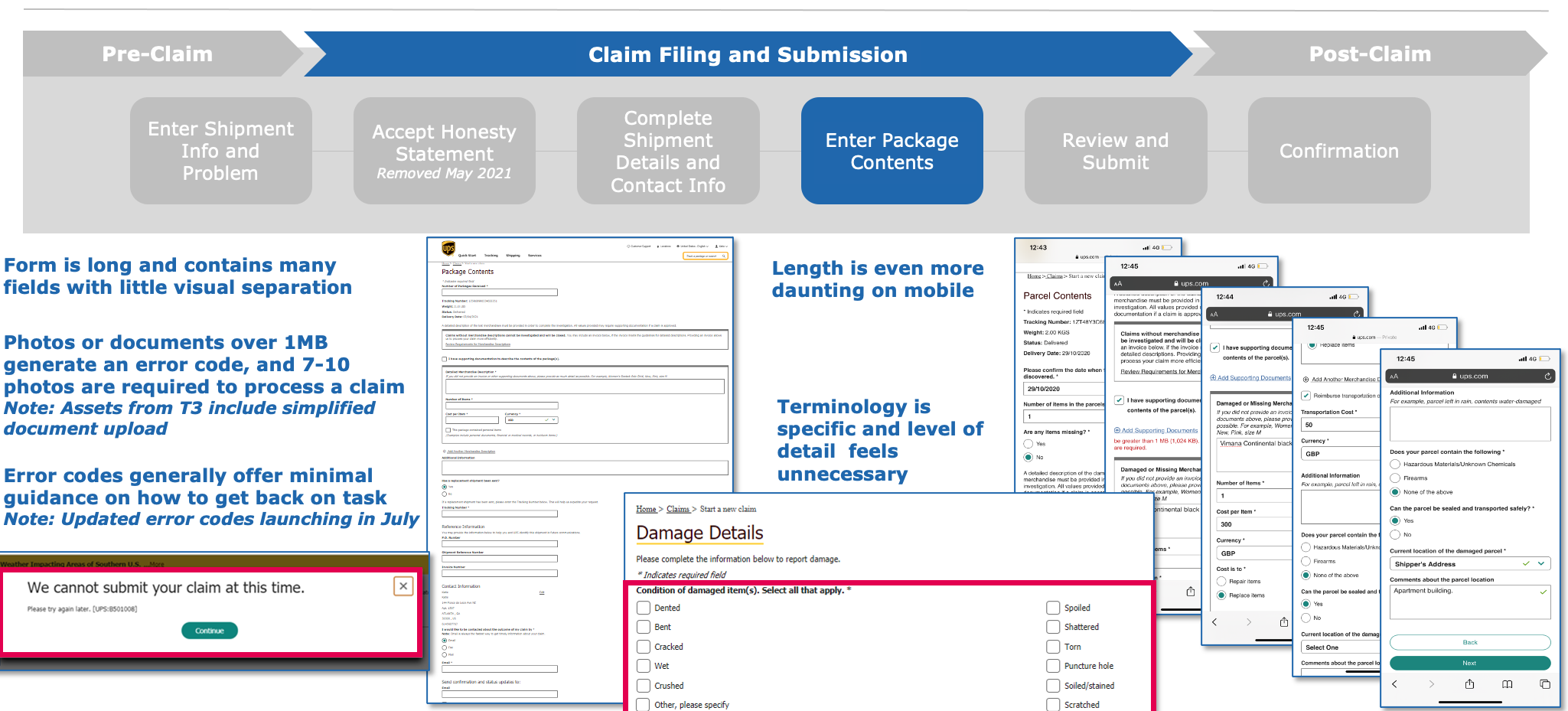
Length continues to feel excessive, and unspecific error codes frustrate the user
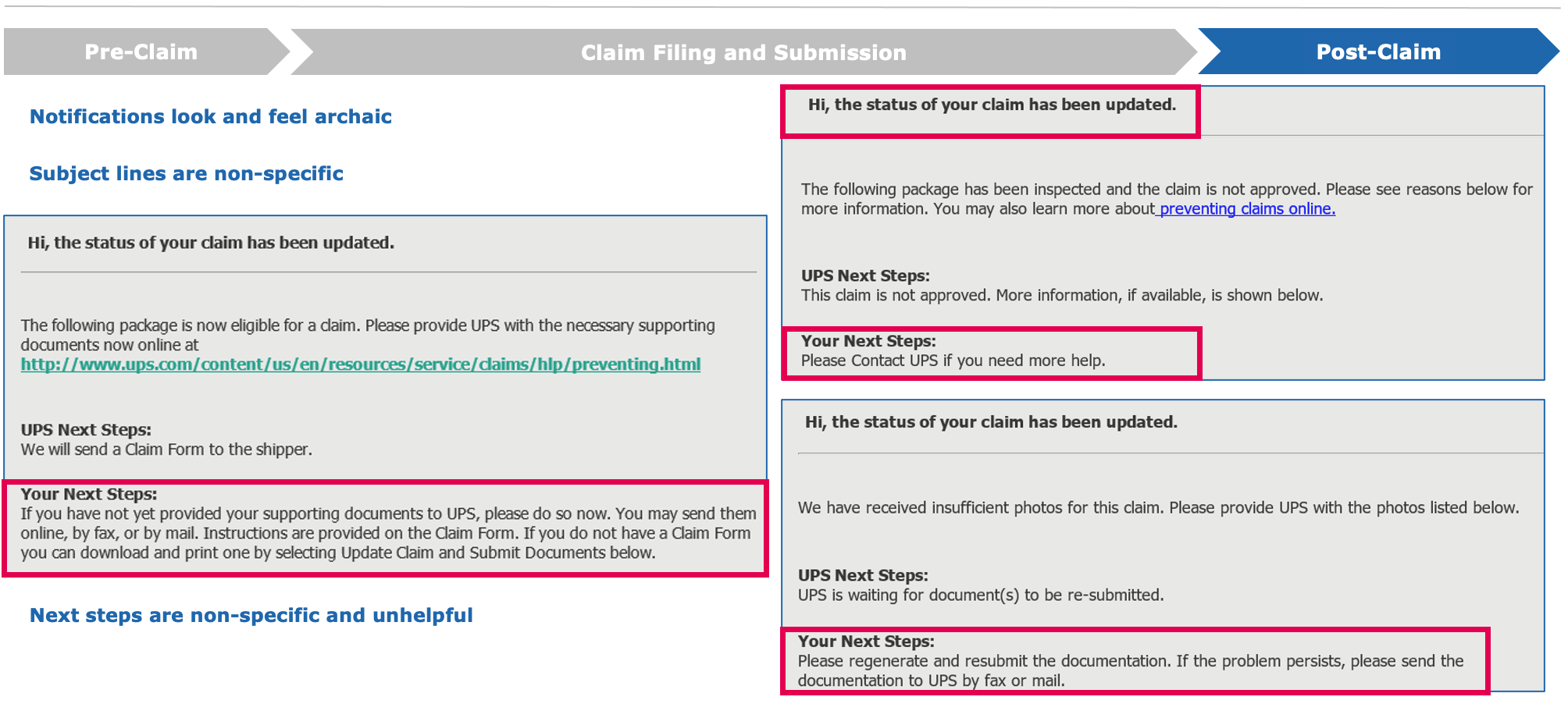
Post-claim notifications look outdated and provide minimal help to the user
As we gathered knowledge and had a baseline understanding now of the issues with the claims process we pivoted to conducting a competitive audit, where we examined how other logistics providers handle claims management, analyzing their approaches and identifying best-in-class practices. Understanding the competitive landscape allowed us to identify opportunities to differentiate UPS and elevate the user experience.
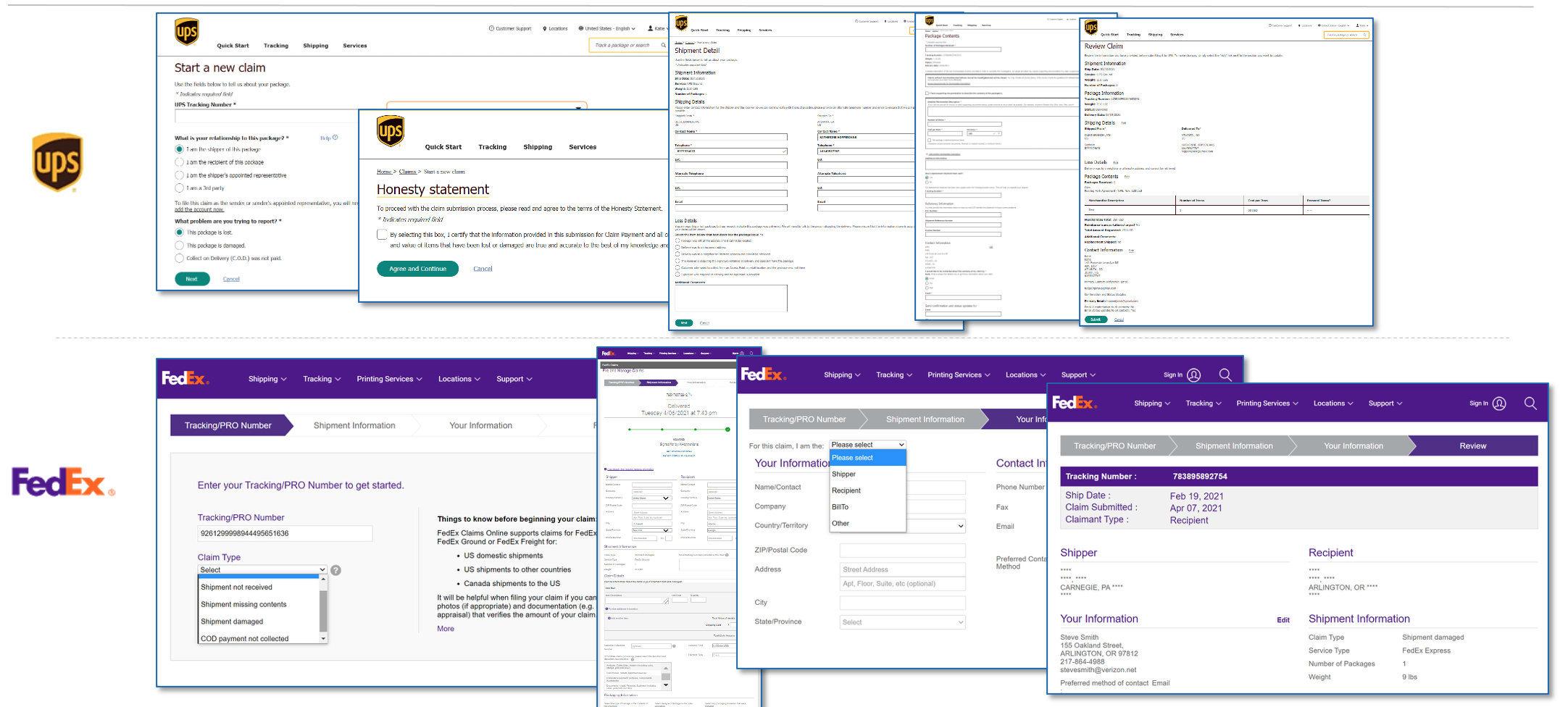
While still long, FedEx’s claims process is a much more intuitive and simplified experience
We expanded our research beyond logistics to examine claims processes in adjacent industries, including automotive and insurance. This cross-industry analysis surfaced innovative patterns and practices that could be adapted to create a more intuitive and efficient claims experience for UPS customers.
Throughout the project, we engaged in extensive stakeholder interviews to deepen our understanding of the claims process from multiple perspectives. These conversations allowed us to validate initial findings from our audit and gather nuanced insights about operational constraints and business requirements. We asked probing follow-up questions based on data we had collected, uncovering hidden pain points that weren't immediately apparent in our quantitative analysis. Through these discussions, we learned about the specific frustrations users experienced at each stage of the journey—from unclear error messages to confusing post-submission requirements. These stakeholder sessions became crucial touchpoints that informed our design decisions, ensuring our solutions addressed real user needs while remaining aligned with business objectives and technical feasibility.
Findings
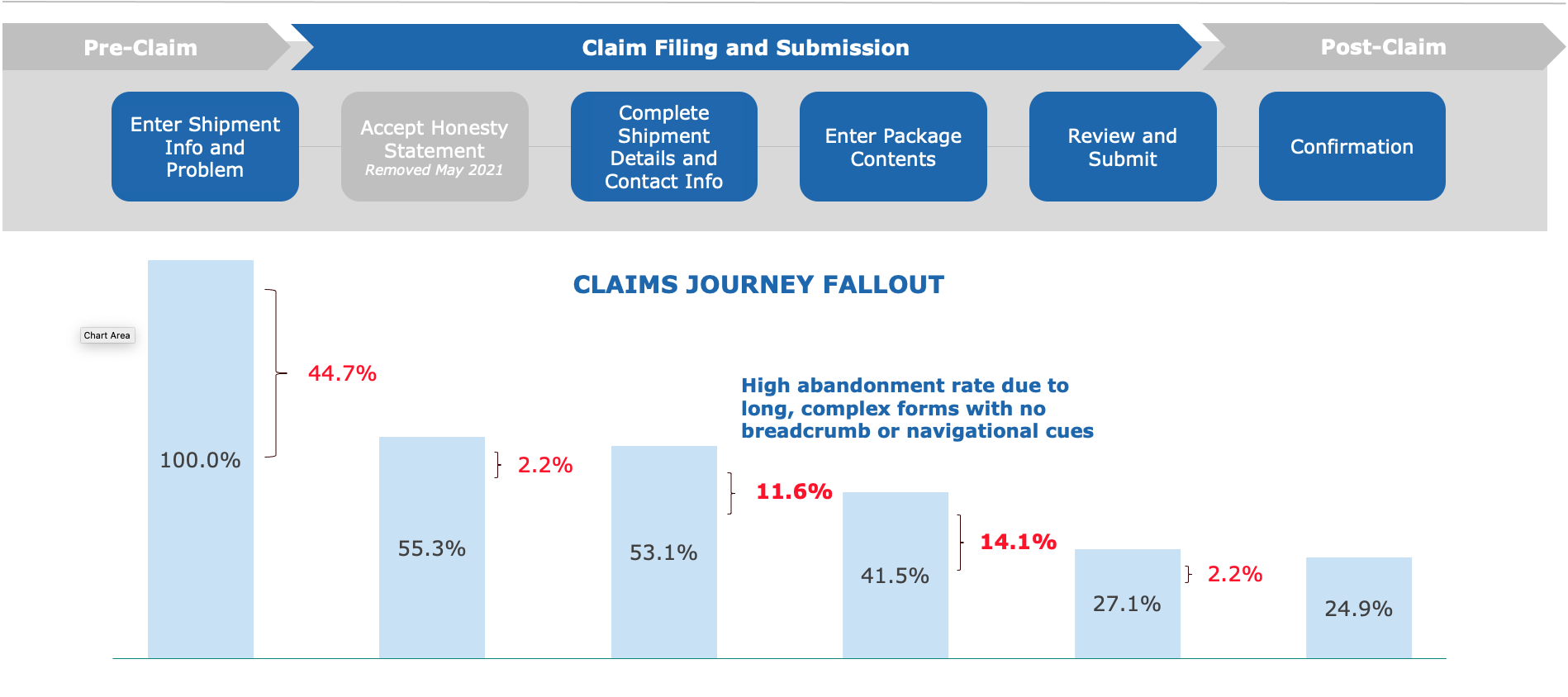
High rates of abandonment when users have already dedicated a significant amount of time
The claims submission process is complex by design, of the 1.2M users who began the claims process on UPS.com in Q1 2021, only 25% completed it. After removing one screen from the process, this increased to approximately 37% in June 2021.
Painful user experience—57 steps on average for the damage flow, taking approximately 15 minutes to complete. 70% of submitted claims are rejected. Unclear communication throughout the flow, including errors, modals, and submission confirmations. Long processing times and unclear post-submission requirements
Focus Areas
Remove unneccesary Friction
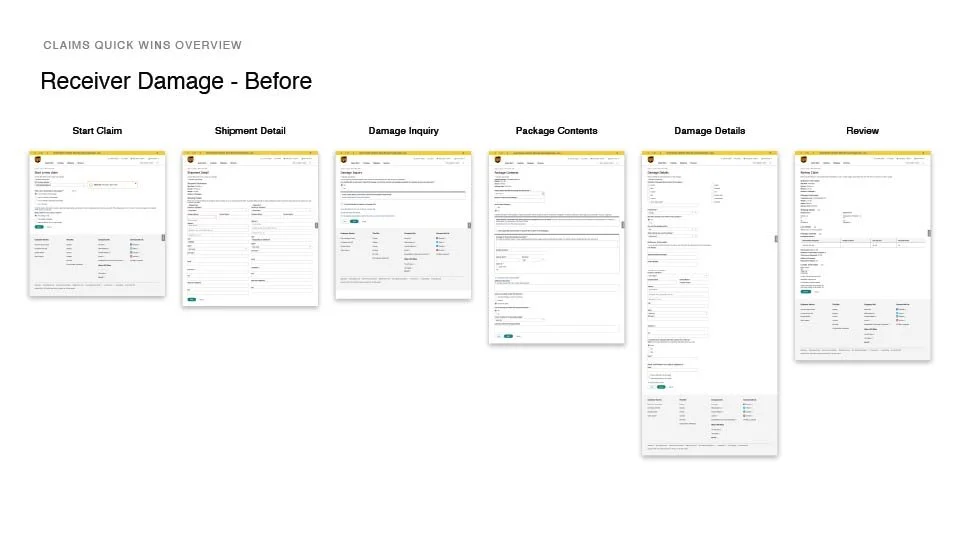
I analyzed the 57-step user journey and identified redundant screens that could be removed without compromising data collection requirements.
I moved dead-end yes/no questions (such as "available for inspection") earlier in the flow to prevent users from investing time only to reach a stopping point later in the process.
I designed screens that dynamically adjust based on known information—for example, only displaying "number of packages received" for multi-piece shipments, reducing cognitive load for single-package claims.
I worked with the development team to identify opportunities to auto-fill fields using existing customer and shipment data, minimizing manual data entry.
Add a Progress Bar
I advocated for and specified the use of a progress indicator component to help users understand where they were in the claims process. I documented requirements for this component and collaborated with the UPS 4.0 design systems team to ensure it would meet our needs. While we used placeholders during development, I defined how the component should function—including what information to display at each stage and how to communicate progress effectively.
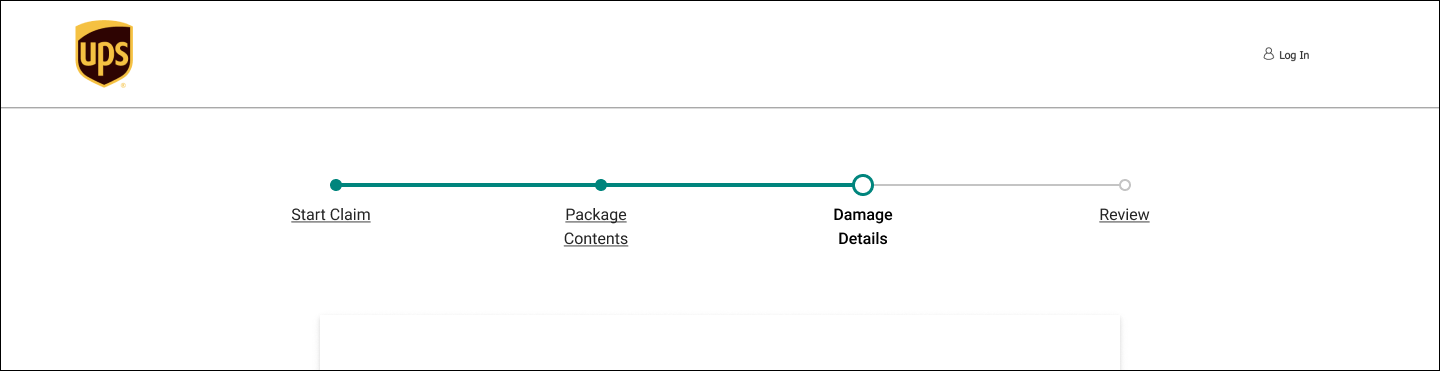
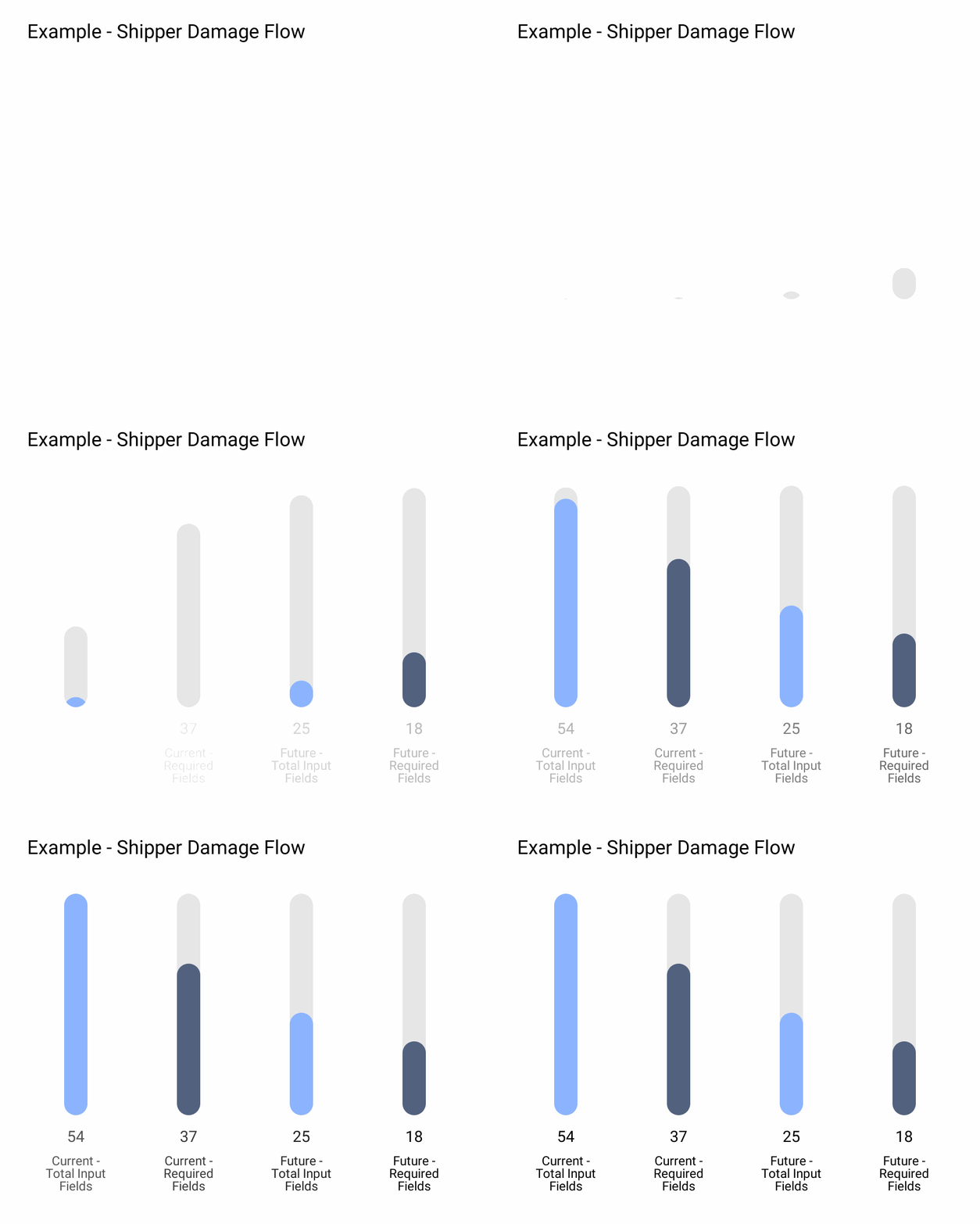
I took ownership of creating a balanced cognitive load across sections by analyzing remaining required fields and strategically redistributing them. I consolidated some sections while breaking others into smaller chunks, creating a rhythm where users felt they were making steady, manageable progress rather than hitting walls of dense information.
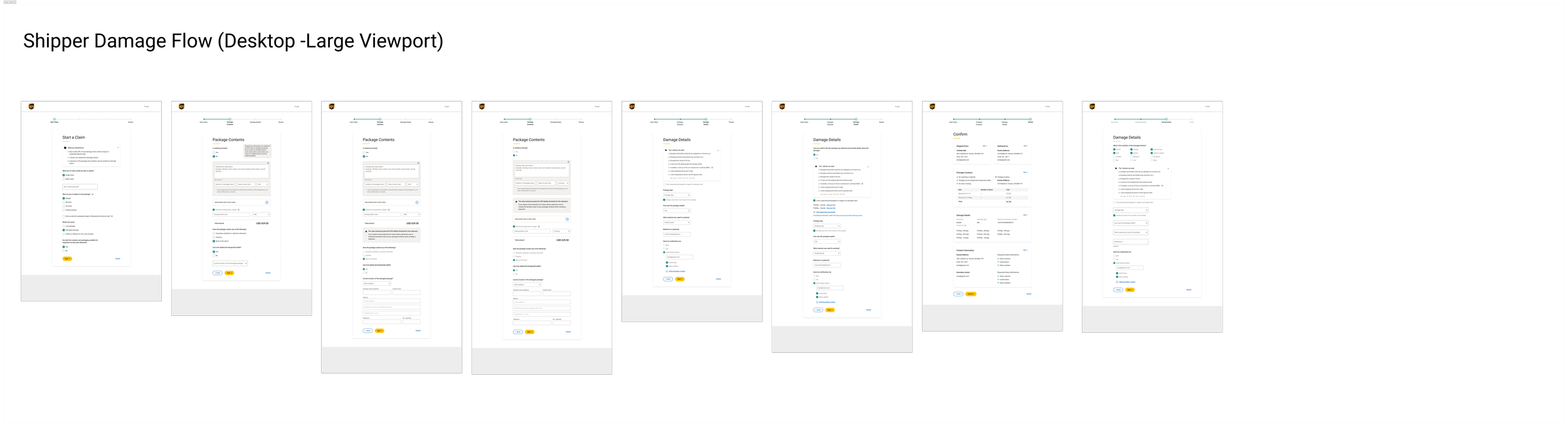
To optimize the UPS claims submission process, we focused on eliminating friction and enhancing user experience. Our main focus was t remove any unnecessary steps and repositioned confirmation prompts strategically to reduce frustration. The process was simplified by streamlining shipment details based on relevance and pre-populating information where possible.
We cut both total and required input fields in half for the shipper damage flow, significantly reducing cognitive load. We also integrated a reimbursement calculator for clear financial guidance and provided an upfront outline of the claims process to set proper expectations. These improvements created a more intuitive information hierarchy, resulting in a more efficient user journey.


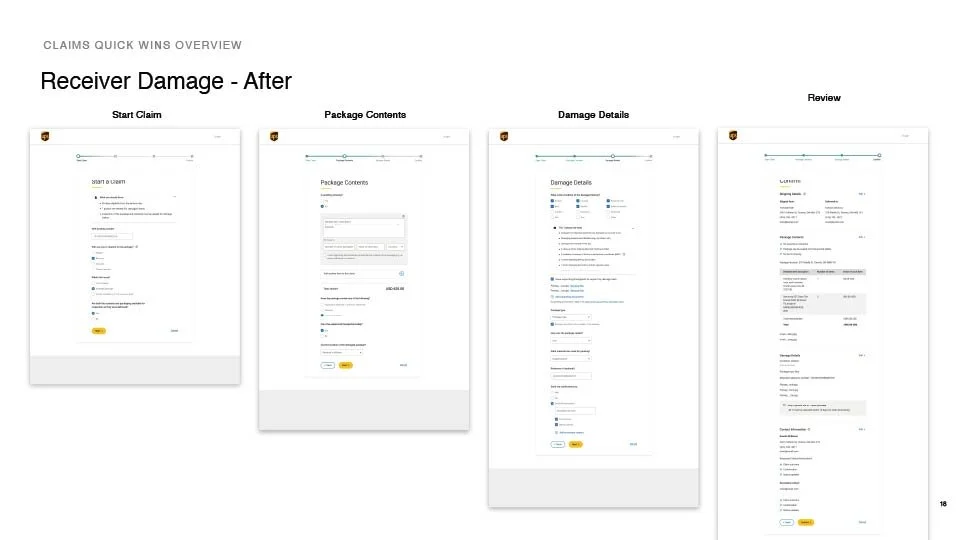
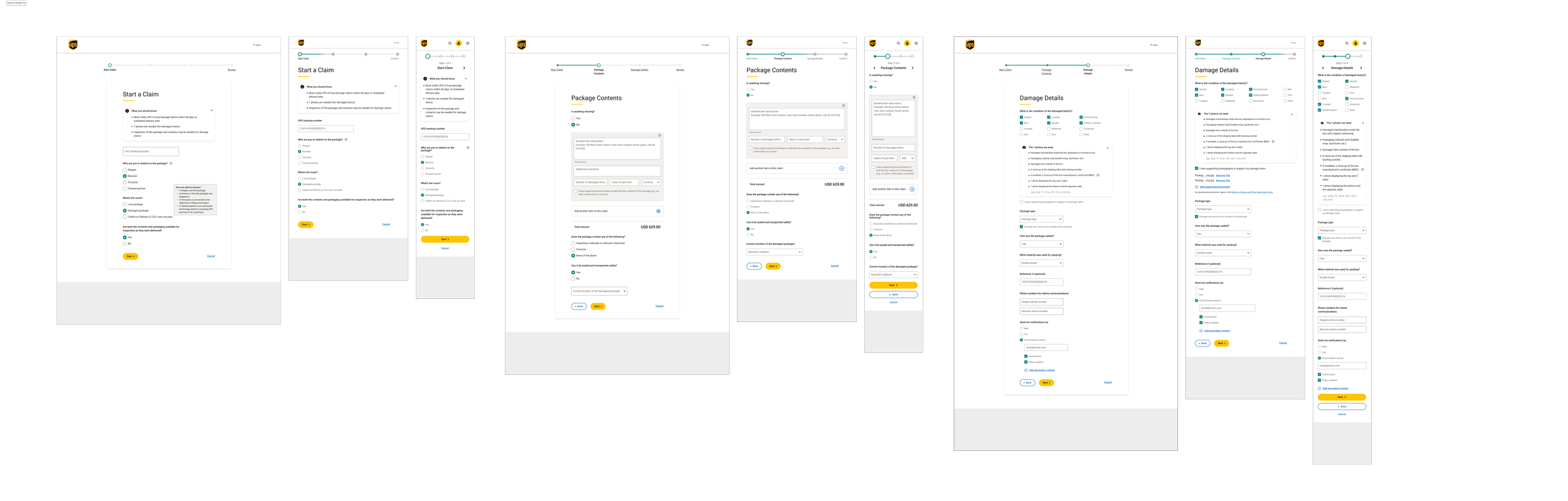
Final Screens
Lorem ipsum, text goes here
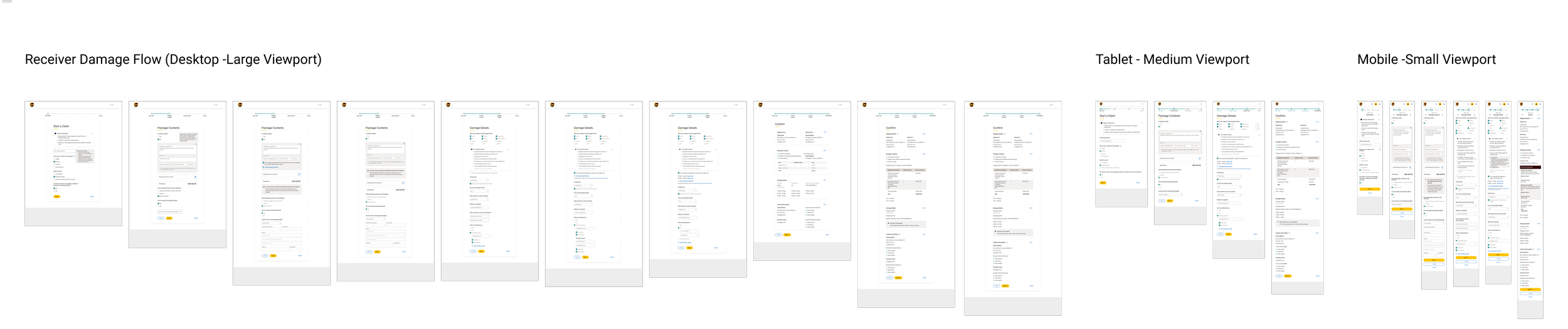
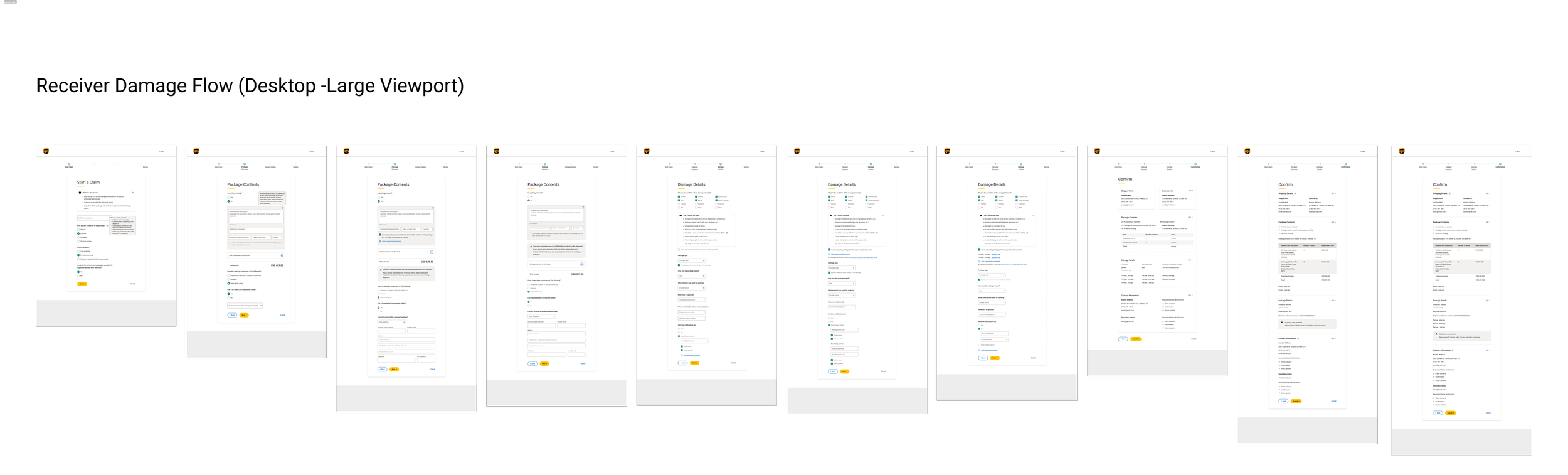
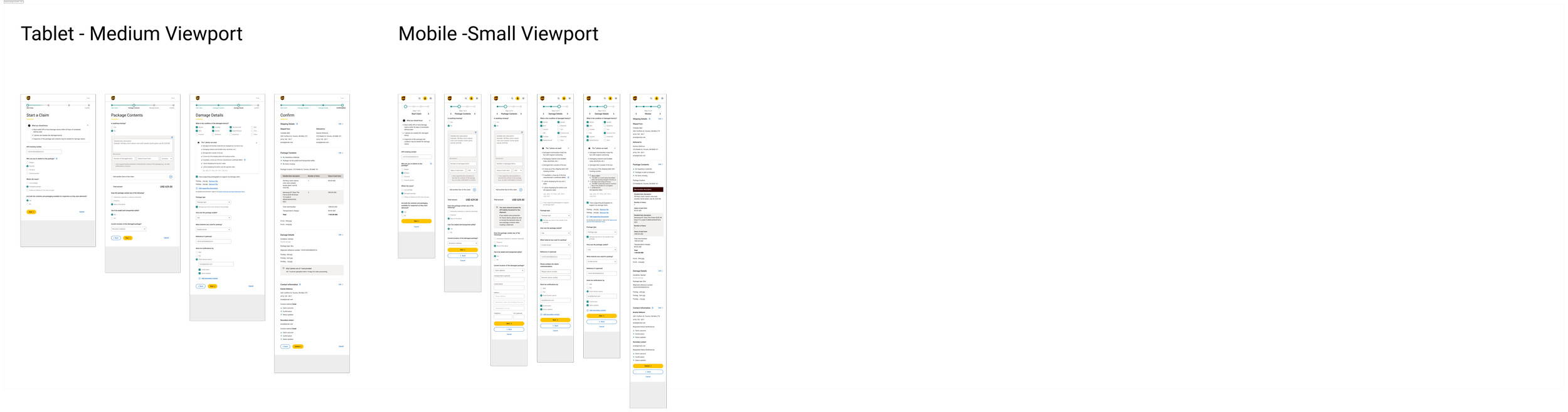
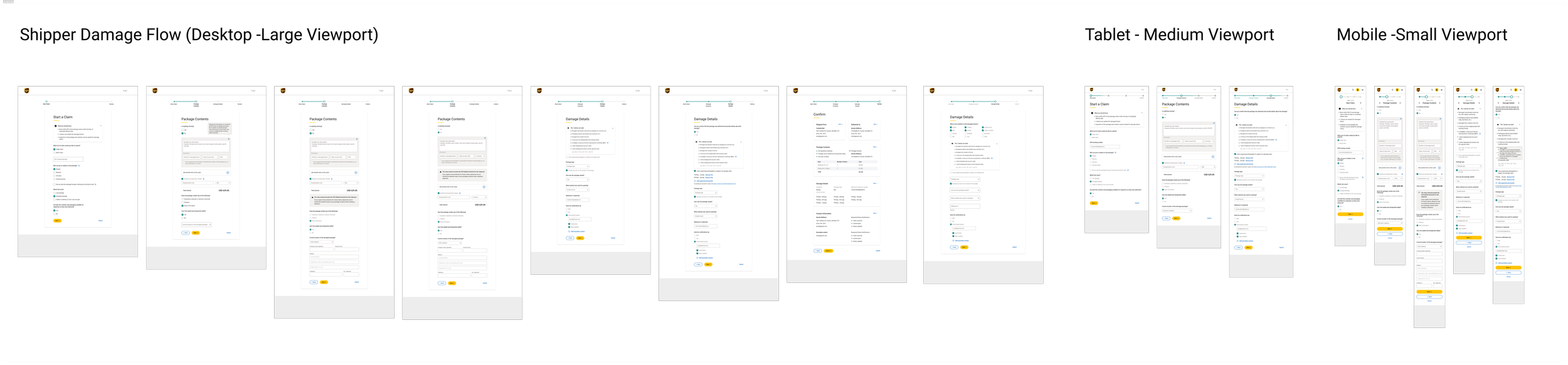

Outcomes
What changed for users?
The claims submission process was simplified, reducing it from an average of 57 steps for the damage flow to a more streamlined process. Shortened flows from 7 pages to 4 pages. Completion time improved from the original ~15 minutes, as evidenced by the significant increase in online submissions. Communication to users was enhanced throughout the flow, addressing previous issues with unclear errors, modals, and submission confirmations. The team implemented clearer requirements and potentially improved processing time post-submission, which was a pain point identified in research.
““Completion rate is up more than 60% since this time last year, and filing is quicker for customers””
These improvements contributed to the dramatic increase in online claim submissions (from 37.7% to 70.8%), suggesting a significantly better user experience.

What changed for the business?
January 2020, 37.7% claims submitted online vs November 2021, 70.8% claims submitted online (globally) Highest on Record!
In November 2021, GBS saved $246,182 as a result of 156,804 more claims being submitted online compared to the previous year. (156,804 claims × $1.57 cost per unit)
2X increase improves the overall experience and reduces cost
““Way to move the “digital” needle for claims on UPS.com AND breaking records along the way!””
“November 2021, 70.8% claims submitted online (globally) Highest on Record!”